Autonomous Take-off, Line-Following, and Landing with Parrot Mambo
| Links: Final Report (PDF)
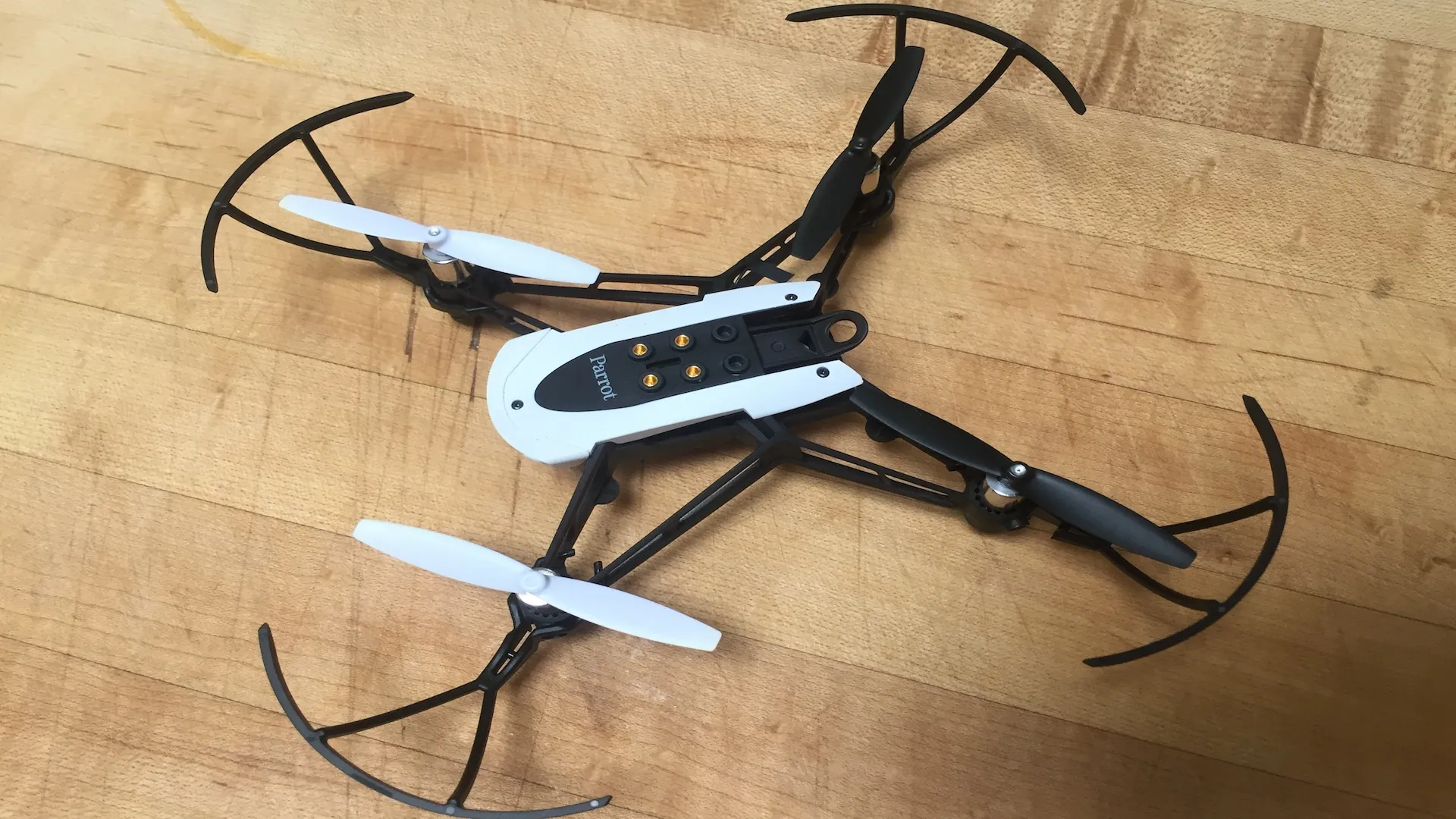
Simulink + Stateflow vision control to take off, track a TI RSLK Max line-follower, and land on a blue moving platform using color segmentation and blob analysis.
A Simulink-based control system that enables a Parrot Mambo minidrone to autonomously take off, track a moving TI RSLK Max line-follower robot, and land on a blue platform mounted on the robot. The drone climbs to ~1 m, uses color segmentation + blob analysis to detect the blue landing pad, and employs a Stateflow controller to center above it and descend smoothly.
Stack: MATLAB/Simulink (Parrot support package) · Stateflow · Arduino (TI RSLK Max) · On-board downward camera.
What’s implemented
- Autonomous flight sequence: take-off → forward flight → visual tracking → hover → controlled descent & landing.
- Blue-pad detection: YUV→RGB conversion, color thresholding, blob analysis to get centroid (x, y).
- Stateflow control: screen divided into 9 zones; generates left/right/forward/back commands until centered; brief hover before descent.
- TI RSLK Max line follower: QTR reflectance sensors + Arduino, carrying the blue landing platform.
 TI RSLK Max line-follower carrying the blue landing platform.
 Parrot Mambo Simulink model: camera → color threshold → blob analysis → Stateflow control.
 Blue blob centroid overlaid on a 3×3 grid for movement decisions.
 Centering, hover, and smooth descent onto the moving platform.
— –>
Demo Video
Details
1) Line-Follower Robot
- TI RSLK Max programmed in Arduino IDE with QTR reflectance sensors for robust path following.
- Blue landing pad fixed on the robot to provide a high-contrast target.
2) Simulink Model (Parrot Support Package)
- After takeoff to ~1 m, the drone switches to forward flight and activates the perception loop.
- Parrot Image Conversion block (Y1UY2V → RGB) → color threshold → binary mask.
3) Color Segmentation & Blob Analysis
- Thresholding isolates the blue region; Blob Analysis returns centroid (x, y).
- Centroid fed into Stateflow to compute movement commands.
4) Stateflow Landing Logic
- Camera view divided into 9 sub-windows (3×3 grid).
- If centroid lies left/right/front/back, command appropriate motion; when centered, hover ~2 s, then descend with a gentle profile.
Results
- Reliable tracking and landing onto a moving target under normal indoor lighting.
- Stable approach with minimal oscillation; smooth touchdown sequence.
- End-to-end pipeline entirely in Simulink + Stateflow (no external localization).
Future Work
- Adaptive gains for varying robot speeds and lighting.
- Add visual-servoing feedback during descent.
- Extend detector beyond color thresholds (e.g., learned detector) for robustness.